
Superior hygiene standards
Our products are built to meet strict hygiene standards. Their smooth surfaces and sanitary seals minimize the risk of product contamination, ensuring the integrity and safety of the fluid being processed.
Traceability
It's important to have complete traceability (the ability to track a product's history, origin, materials, and movement throughout its lifecycle) of all components, including valves.
Our factory
Our company has a workshop area of 50,00 square meters and more than 100 employees. In our locations, there are many mature parts supply chains and experienced employees, which makes us unique.
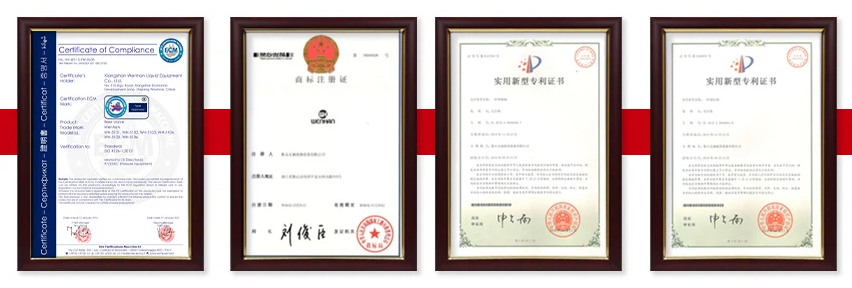
Our certificate
National High-Tech Enterprise, Demonstration unit of double guarantee of quality and reputation, Zhejiang Science and Technology Innovation Enterprise Technology Company,AAA enterprise credit and more than 10 practical patents, In 2013, it was rated as a science and technology enterprise in Zhejiang Province, In 2018, it was rated as a national high-tech enterprise and a double-guaranteed enterprise for quality and reputation, in 2019, it was rated as a national high-tech enterprise and a double-guaranteed enterprise for quality and reputation, Was rated as a national science and technology enterprise and many other honors.
Surface acoustic wave (SAW) testing volume meters
SAW testing volume meters are non-intrusive devices that use surface acoustic waves to measure the flow rate of a fluid. They operate by analyzing the changes in wave propagation caused by the fluid flow. SAW testing volume meters offer advantages such as non-intrusiveness, high accuracy, and low maintenance requirements. They find applications in food processing, water management, chemical processing, and oil and gas.
Differential head testing volume meters
Differential head testing volume meters measure the flow's pressure difference across an obstruction. They take advantage of Bernoulli's Principle, which states that the differential pressure across the obstruction is proportional to the flow rate's square. The main styles of differential head testing volume meters are orifice plate, venturi, and Annubar.
Differential area (rotameters)
Rotameters have a tapered tube, similar to venturi differential head testing volume meters, to cause a pressure drop in the testing volume meter. They also have a float balanced by the flowing fluid's upward force. The float's position indicates the flow rate.
Mechanical testing volume meters
Mechanical or turbine testing volume meters differ from electronic testing volume meters because they have a rotor with blades or vanes in the flow's path. The flow spins the rotor at a speed proportional to the flow velocity. Read our article on paddle wheel testing volume meters to learn more.
Ultrasonic testing volume meters
Ultrasonic testing volume meters transmit ultrasonic signals through the media to measure the time necessary for the signals to travel upstream and downstream. The transit time difference allows for calculating the flow rate. These meters are non-intrusive and are suitable for a variety of fluid types.
Vortex testing volume meters
Vortex testing volume meters use the von Kármán effect. Within the meter is a blunt, raised area. As the fluid flows past this area, alternating vortices are created. A flexible sensor tab in the testing volume meter bends and flexes to measure the frequency of the vortices. The frequency of vortices is proportional to the flow rate. These testing volume meters are highly accurate and suitable for a range of fluids.
Magnetic testing volume meters
Magnetic testing volume meters take advantage of Faraday's law of electromagnetic induction. This testing volume meter creates a magnetic field. When conductive fluid flows through the magnetic field, an electromotive force (voltage) proportional to the flow rate is produced. These testing volume meters are best for conductive fluids like water, wastewater, and chemicals. They have relatively small pressure drops.
Oil and gas
For an industry that deals with large volumes of liquid and gas, volumetric testing volume meters are indispensable for ensuring precise fuel measurements and optimizing processes.
Food and beverage
In maintaining ingredient ratios or managing sanitary wastewater, liquid testing volume meters play a vital role in ensuring product quality and compliance with health regulations.
Pharmaceuticals
Precision is paramount in drug formulation and processing. Volumetric testing volume meters help maintain rigorous standards by ensuring accurate fluid measurement.
Water treatment
From treating wastewater to managing water supplies, volumetric testing volume meters provide reliable measurements critical for operational efficiency.
Chemical industry
Dealing with hazardous materials necessitates precise flow control. Gas testing volume meters help manage gas-based reactions and ensure safety.
A testing volume meter is an instrument used to measure linear or nonlinear mass or volumetric flow of a liquid, gas, or vapor. These devices can measure the liquid, gas, or vapor flowing inside them during a set period of time. They can also measure the total amount of matter that has gone through them. We offers both in-line and clamp-on testing volume meters. An in-line testing volume meter has a flow line installed in a process line and has a built-in flow conditioner that enhances the profile of the process liquid, gas, or vapor. With clamp-on testing volume meters, you can choose where to measure without disrupting production. They are easy to install without process shutdown and versatile for a variety of industries, substances, and pipe thicknesses.
All testing volume meters essentially have the same goal—to measure flow by recording how much liquid, gas, or vapor flows through a fixture. However, they do not necessarily go about it in the same way. It depends upon the type of testing volume meter you are using. For instance, ultrasonic testing volume meters use ultrasound to measure the speed and volume of a liquid, gas, or vapor flowing through a pipe. An ultrasonic signal is sent to the material flowing downstream. Another signal is sent against the substance flowing upstream. This type of testing volume meter measures and compares the two ultrasonic transmissions. Using this data you can calculate different types of data, such as flow velocity or volume. A magnetic testing volume meter, on the other hand, uses a magnetic field to measure the speed a liquid, gas, or vapor flows through a fixture, such as a pipe. When a substance, such as a fluid, flows through the created magnetic field, it generates voltage depending on the speed. Quicker fluid generates more voltage versus a slower flow.


As an engineer or technician, getting repeatable and accurate measurements from your testing volume meter is critical. However, this cannot happen if you are using the wrong type of testing volume meter or incorrectly installing your instrument. Therefore, it is just as important to determine if your application requires a mass testing volume meter or a volumetric testing volume meter. Each type has its own set of benefits and can be used across many industries and for various applications.
For starters, let’ s review the differences between mass and volumetric flow rates as it is common for some people to confuse mass flow rates and volumetric flow rates with velocity or air speed. In mass testing volume meters, the flow rate is calculated by measuring the amount of mass of a substance passing through a device for a given amount of time. In volumetric testing volume meters, the flow rate is calculated by measuring the volume of a substance through a device over a given period. It is also important to keep in mind that there are various types of substances that can pass through a testing volume meter such as liquids and gases. Another key difference when it comes to mass and volumetric testing volume meters are the various types of instruments available for each testing volume meter and are selected depending on the desired application. Mass and volumetric testing volume meters also vary in the way they operate and function to measure flow.
Thermal mass testing volume meters operate by utilizing thermal sensing technology. As flow enters the device, a small portion is redirected into a small tube containing two coils – one downstream from the other. The first coil introduces a small amount of heat into the gas stream. As the gas passes through the tube, the smart electronics sense the amount of heat transferred from one coil to the other. The output of the thermal mass flow sensor is directly related to the specific heat characteristic of the gas being measured. Therefore, if a unit is calibrated for air, it is a relatively simple calculation to figure the calibration for nitrogen or some other similar gas. This advantage offers flexibility not found on many other types of flow sensors.
On the opposite end, turbine testing volume meters operate by utilizing the pelton turbine wheel concept. As flow passes through the device, it is directed onto the very small teeth of the wheel using a precision-machined nozzle. This nozzle is sized per the flow range of the unit. The rotational speed of the turbine wheel increases proportionally to the volumetric flow rate. The microturbine wheel has alternating white and black sections evenly spaced on one surface of the wheel. As the wheel rotates, an infrared beam is reflected off each white section and is directed to a phototransistor which detects each reflected beam and converts them into pulses. As the wheel spins faster, pulse rate increases. When the wheel stops (under zero flow conditions), no pulses are generated. Consequently, zero drift is not possible and zero adjustments are never required.
Maintenance of Testing Volume Meter
Installation stress may be generated during the initial installation of the flowmeter, which may cause the zero point of the flowmeter to change and cause measurement errors. Therefore the flowmeter zero must be checked after the initial installation of the flowmeter. If the zero point changes, the zero point correction operation should be carried out. The flowmeter is preheated, and the sensor is wetted with the measured medium to make its temperature close to the normal working temperature. Then stop the medium flow (close the valves on both sides of the flowmeter) to ensure that the sensor is in a full pipe state. Wait for 3 to 5 minutes to ensure that the fluid completely stops flowing. Take measures to ensure that the pipeline and sensor are in a static state. Prevent pipeline vibration from affecting the correct zeroing process.
Carry out the zero point calibration operation according to the instructions of the zero point calibration operation in the manual of the converter. At this time, the indicator light is displayed, indicating that the zero point calibration is in progress (the zero point operation lasts for a few seconds). Until the status indicator light goes out, the instrument displays normally. The instrument is zero End, this process takes about tens of seconds. Due to its structural characteristics, the mass flowmeter generally does not require special maintenance during use. However, in some special use conditions, appropriate maintenance measures should be taken to ensure the accurate and reliable operation of the flowmeter. When there are particles in the fluid that may accumulate in the vibrating tube, they should be checked and eliminated regularly so as not to affect the normal use of the flowmeter. When the measuring medium may adhere to the inner wall of the vibrating tube, it should be purged regularly so as not to affect the normal use of the flowmeter. When there are particles in the measurement medium and the vibrating tube may be worn, it should be checked and dealt with in time.
During the initial installation and use, if the flowmeter is found to be working abnormally, the cause of the failure should be determined. The cause of failure can be divided into two types: application problems and testing volume meter system problems. The application problem is more complicated. For example, the measurement fluctuation error caused by the process and the state change of the medium should be analyzed according to the actual situation. For the fault diagnosis of the flowmeter, the user can use the LED indicator light on the panel and the LCD display. The different colors of the LED indicator light represent the working status of the flowmeter, which is convenient for the user to check the working status. The LCD display can display the alarm of the transmitter self-diagnosis information, which is helpful for users to judge and define faults.
Our company has a workshop area of 50,00 square meters and more than 100 employees. In our locations, there are many mature parts supply chains and experienced employees, which makes us unique. After several years of development, we have a large-scale, high-quality production capacity. Our products are widely used in the dairy, food, beer, beverage, pharmaceutical and cosmetic industries.


We're well-known as one of the leading testing volume meter manufacturers and suppliers in China. Our factory offers high quality testing volume meter made in China with competitive price. Welcome to contact us for wholesale service.
senninger pressure regulator, hayward pressure regulator, lever operated ball valve(0/10)



