
Superior hygiene standards
Our products are built to meet strict hygiene standards. Their smooth surfaces and sanitary seals minimize the risk of product contamination, ensuring the integrity and safety of the fluid being processed.
Traceability
It's important to have complete traceability (the ability to track a product's history, origin, materials, and movement throughout its lifecycle) of all components, including valves.
Our factory
Our company has a workshop area of 50,00 square meters and more than 100 employees. In our locations, there are many mature parts supply chains and experienced employees, which makes us unique.
Our certificate
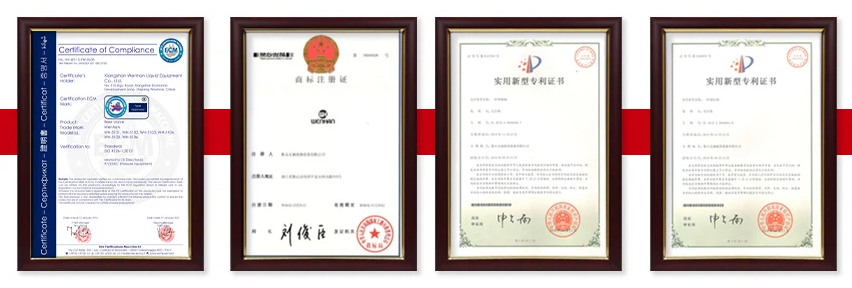
National High-Tech Enterprise, Demonstration unit of double guarantee of quality and reputation, Zhejiang Science and Technology Innovation Enterprise Technology Company,AAA enterprise credit and more than 10 practical patents, In 2013, it was rated as a science and technology enterprise in Zhejiang Province, In 2018, it was rated as a national high-tech enterprise and a double-guaranteed enterprise for quality and reputation, in 2019, it was rated as a national high-tech enterprise and a double-guaranteed enterprise for quality and reputation, Was rated as a national science and technology enterprise and many other honors.
Absolute pressure gauge
Absolute pressure gauges are used to measure pressure independent of the natural fluctuations in atmospheric pressure. A reference vacuum is attached to the side of the measuring element, which is not subject to pressure; it has zero pressure with no variation. A diaphragm separates the media chamber from the vacuum chamber and deforms into the vacuum chamber as pressure rises. The deformation and change is converted into a pressure value. Unlike other pressure gauges, absolute pressure gauges are not influenced by changes in altitude, which makes them ideal for use in aeronautics, hvac systems, and distillation processes.
Bellows pressure gauge
The bellows in a bellows pressure gauge is made of thin walled springy metal connected tubes that form a shape similar to an accordion; this is sealed in the free end of the gauge. As pressure is applied, it acts on the bellows on the free end, causing it to expand and produce movement. Bellows pressure gauges are very sensitive and used for low pressure applications. There are two forms of bellows gauges. In one form, pressure is applied to the bellows, resulting in a deformation on a counterbalanced spring. Another form uses the differential pressure principle with the bellows sealed between the two chambers of differing pressures.
Bourdon tube pressure gauge
A bourdon tube pressure gauge has an elastic tube that is soldered or welded on one end into a socket. A change in pressure causes deflection in the tube; this is proportional to the applied pressure and is sent to a rotary gear with a pointer. The operating principle of a bourdon pressure gauge is that a curved tube will straighten when pressure is applied; this is indicated by a dial or digital readout. Bourdon tube pressure gauges are used to measure pressure up to 1000 bar and down to -1 bar of gas, steam, or fluids. They have accuracy between ± 0.1% and ± 2.5% of full scale deflection and are made of brass, stainless steel, or monel, a nickel alloy.
Capsule pressure gauge
A capsule pressure gauge has two thin, concentric corrugated diaphragms that are sealed tightly together around their circumferences. One of the diaphragms has a hole in the center that allows the medium to enter. When pressure is applied, the diaphragms expand or contract. This change in shape creates rotary movement that appears on the face of the gauge. Capsule pressure gauges are used for the measurement of substances with pressures up to 600 mbar with an accuracy of ± 1.6%, and they are used exclusively for measuring the pressure of gases.
Diaphragm pressure gauge
A diaphragm pressure gauge is elastic and becomes displaced when pressure is applied. This type of pressure gauge works on the same principle as a bourdon pressure gauge but measures pressure using a diaphragm instead of a flexible tube. The diaphragm, which is placed between two flanges, is used to determine the difference between the applied pressure and the reference pressure. It can measure pressure as high as 40 bar to -1 bar of gas, steam, and fluids. The main use of a diaphragm pressure gauge is for measurement of low level pressure.
Differential (dp) pressure gauge
Differential pressure gauges measure the difference between the pressure in two chambers that are separated by an element that moves back and forth according to the changes in pressure. The movement of the element causes a movement in the pointer on the gauge face or provides a digital display reading. One of the ports of the gauge is installed on the high side, while the other is placed on the low side that shows a pressure drop on the gauge. In some cases, a linear magnetic piston is placed between the two pressure chambers that tugs at a rotary magnet connected to the gauge pointer or digital display. Differential pressure gauges are popular due to their simplicity.
Manometer pressure gauge
Manometer pressure gauges measure pressure on a fluid by balancing one column of fluid against a second column of fluid. This type of pressure gauge is the simplest type and consists of a transparent tube in the form of a "u" that is partially filled with a manometric fluid like mercury. In its simplest form, one end of the tube is connected to the location in which pressure is to be measured, while the other end is open to the atmosphere.
Piezometer pressure gauge
A piezometer is a type of manometer that is used to measure the medium pressure range of liquids; it is a simple glass tube that is open at both ends. One end is connected to a pipe line where the pressure of a fluid is to be measured, while the other end is open to the atmosphere. The tube is attached vertically such that the liquid in the pipe can rise into the tube. The pressure reading is indicated by the height of the fluid in the tube.
Process control
Pressure gauges are used in industrial processes to monitor and control the pressure of fluids and gases in pipes, tanks, and vessels.
Safety
Pressure gauges are used to ensure that systems are operating within safe pressure limits. This is important to prevent system failure, equipment damage, and worker injuries.
Quality control
Pressure gauges are used in manufacturing processes to ensure that products are produced to specific pressure requirements.


Maintenance
Pressure gauges are used during maintenance and troubleshooting to diagnose problems with industrial systems and equipment.
Research and development
Pressure gauges are used in research and development to measure pressure changes during experiments and simulations.

Environmental monitoring
Pressure gauges are used to measure pressure changes in environmental monitoring systems, such as weather stations and air pollution sensors.
Pressure monitoring is critical for the safe and proper operation of a variety of industrial systems. Without an accurate mechanism to measure and alter the pressure, entire fluid power systems would be erratic and unreliable and, hence, useless. Measuring liquid pressure using a pressure gauge is critical for maintaining mechanisms that rely on appropriate pressure control and properly operating mechanisms that rely on pressure control values.
Pressure gauges can be used for several purposes. For example, the water or air that travels through our household water systems and tanks makes them work. A pressure gauge is used to check for faults in the tanks or systems by measuring the force of pressure in the water or air. You can use them on a well system's storage tank to ensure that the pump turns on and off appropriately.
Industrial usages include utilizing gauges on water treatment machinery and reverse osmosis systems, where pressure is a critical component of the system's performance. If you're wondering, "What should the water pressure in my pumping system be?" you should know that water pressure regulators that are used in municipal water supply systems distribute water to property holes at 50 to 70 PSI. There is an easy way of testing your water pressure if you think it is either too high or too low: use a PSI-measuring pressure gauge. There are two basic types of gauges found in pumping systems, pressure gauges and compound gauges, which measure both vacuum and pressure. All gauges indicate the difference in pressure between the port and the outside environment. For example, if we have a pressure gauge installed in a pipe that reaches 30 PSI and the environmental pressure is 13 PSI absolute, the absolute pressure in the pipe would be 43 PSI.
How to Read a Pressure Gauge
You can read a pressure gauge by simply matching the needle to the number on the dial. Digital pressure gauges will read the exact PSI, while an air pressure gauge, like a tire gauge, will shoot out a little stick marked with measurements of PSI. The stick will line up with the end of the gauge so you can read the pressure. Pressure gauges come in a variety of calibrations. They can range 0 to 15 pounds per square inch (PSI), all the way up to a range of 0 to 1,000 PSI. Make sure the gauge you are using is compatible with the scale of the application you are using it in. You can determine whether the pressure is too high or too low based on what parameters you are looking to operate under.
Pressure gauges provide information that allows you to monitor equipment. If you see pressure reading too high or low, it could be an indication that you need to fix something in our tank or filtration system. For example, if you monitor pressure differential across the inside of a filter and the outside, or the effluent side, of that filter, and the pressure is dropping too low, it may mean that the filter is clogged and needs to be changed. In this case, the water will eventually stop flowing into your house or through your equipment if the filter is not changed. If the pressure on your gauge reads too high, you may also have to take action. Extra-high pressure could result in a catastrophic failure. Fittings or tubing could burst, or housings could come apart. If this happens, you will begin to experience leaks that could result in flooding and potential danger to your home or office.
Case
Pressure gauge cases can be made of steel, brass, plastic or the most commonly used, stainless steel. The complexity of design and material used in construction determines gauge quality and pricing. Aggressive, harmful environments, such as those for chemical and petrochemical production, call for phenolic cases, which use a resin made from phenols and aldehydes. Cases may be filled with glycerin or silicone, both of which are used to prevent condensation, as well as protect against corrosive environments that could damage the internal mechanism. Rubber gauge covers are used when there is the need to protect the case from impact damage.
Socket
The first part of the pressure gauge the pressurized fluid comes in contact with is the socket. More expensive gauges have a threaded hole for inserting a restrictor orifice, which prevents particles from entering and jamming the gauge. Less expensive gauges have a hole drilled at the outlet connection.
Welding
One end of the bourdon tube is welded where the linkage is attached. In a less expensive gauge, a stamping or mechanical device is used to attach the linkage.
Pointers
Pointers vary depending on the pointer’s complexity and types of fine adjustments the pointer permits. More complex, refined pointers allow for changes in altitude or wear from pulsations and vibrations.
Display
Pressure gauge readings are displayed in analog, digital or dial fashion and vary depending on the type and design of the pressure gauge. The dial scale of the pressure gauge is calibrated to the design and type of pressure gauge, whereas the dial for the bourdon tube pressure gauge is calibrated to the bourdon tube. Pressure gauges provide readings through either a dial fashion analog display or a digital readout. The choice of display is dependent on the specific type and design of the pressure gauge. The dial of a pressure gauge is calibrated to align with its unique design and type. In this case, the dial is calibrated to the bourdon tube. Analog pressure gauges, also known as dial pressure gauges, exhibit a scale that is segmented into three sections. Among these sections, the first and third are comparatively less accurate, while the middle or second section boasts the highest degree of accuracy. When opting for an analog pressure gauge, it is preferable for the intended pressure range to coincide with the middle section of the dial. While the middle part of the dial provides the most accurate pressure measurements, certain pressure gauges achieve high accuracy across the full scale of the dial at 1%.
Our company has a workshop area of 50,00 square meters and more than 100 employees. In our locations, there are many mature parts supply chains and experienced employees, which makes us unique. After several years of development, we have a large-scale, high-quality production capacity. Our products are widely used in the dairy, food, beer, beverage, pharmaceutical and cosmetic industries.


We're well-known as one of the leading pressure gauge manufacturers and suppliers in China. Our factory offers high quality pressure gauge made in China with competitive price. Welcome to contact us for wholesale service.
cash acme pressure reducing valve, on off ball valve with pneumatic actuator, pressure regulator valve cost(0/10)



